What Are Stocks?
Understand what stocks represent and what it means to be a shareholder in a company.
Learning Objectives
- Define what a stock is and what it represents
- Understand the concept of ownership through shares
- Learn key terminology like shareholder and equity
- Recognize the rights that come with stock ownership
What Are Stocks?#
When you hear about the stock market in the news or see ticker symbols scrolling across a screen, you're witnessing one of the most powerful wealth-building tools available to everyday people. But what exactly are stocks, and why should you care about them?
A stock is a type of investment that represents ownership in a company. When you buy a stock, you're purchasing a small piece of that business and becoming a part-owner.
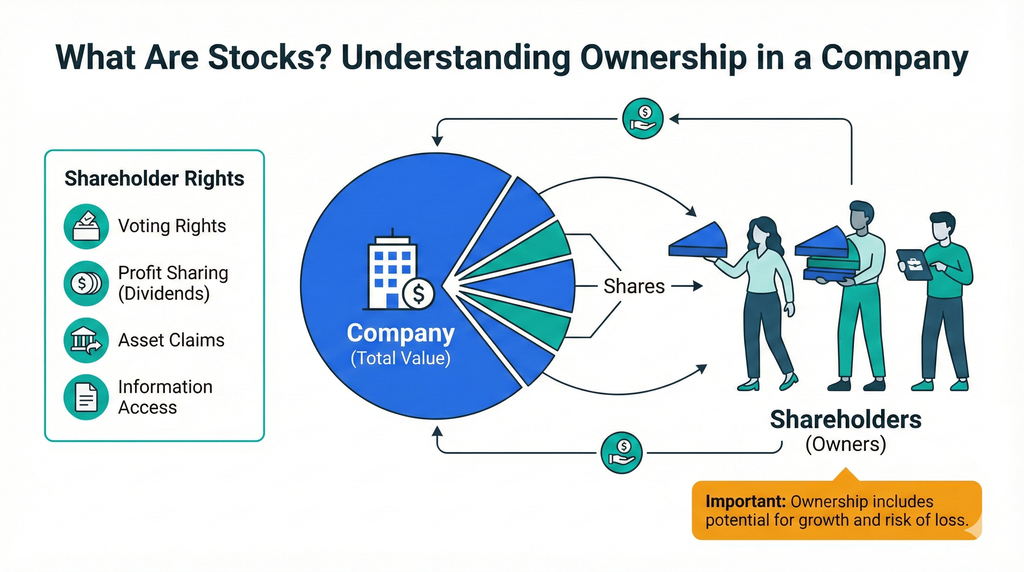
The Pizza Analogy#
The easiest way to understand stocks is through a simple analogy. Imagine a company as a whole pizza. When that company decides to "go public" and sell stock, it's essentially cutting that pizza into thousands or millions of tiny slices.
Each slice is called a . When you buy shares, you're buying slices of that pizza. The more slices you own, the bigger your portion of the company.
What Does Ownership Mean?#
When you own stock in a company, you become a (also called a stockholder). This ownership comes with several important rights:
| Right | Description |
|---|---|
| Voting Rights | Vote on important company decisions at shareholder meetings |
| Profit Sharing | Receive a portion of profits through dividends (if paid) |
| Asset Claims | Entitled to company assets if it's sold or liquidated |
| Information Access | Receive annual reports and financial statements |
Good to Know
Your ownership percentage is tiny unless you're a major investor. If a company has 1 billion shares outstanding and you own 100 shares, you own 0.00001% of the company. But that small slice still entitles you to all shareholder rights!
Stock vs. Equity#
You'll often hear the term equity used alongside stocks. These terms are closely related:
- Stock refers to the actual shares you can buy and sell
- Equity refers to the ownership value those shares represent
When someone says they have "equity in a company," they mean they own a portion of it, typically through stock.
A Real-World Example#
Let's make this concrete. Suppose you buy 10 shares of a company called "CoffeeCo" at $50 per share:
- Your investment: 10 shares × $50 = $500
- If CoffeeCo has 10 million shares: You own 10 ÷ 10,000,000 = 0.0001% of the company
- If CoffeeCo's total value is $500 million: Your 0.0001% stake is worth $500
If CoffeeCo grows and the stock price rises to $75:
- Your shares are now worth: 10 × $75 = $750
- Your profit: $750 - $500 = $250 (a 50% gain!)
This is the fundamental appeal of stock investing: as companies grow and become more valuable, so does your investment.
Why Stocks Exist#
Stocks exist because companies need money to grow, and investors want opportunities to build wealth. It's a mutually beneficial arrangement:
- Companies get capital to fund operations, expand, and innovate
- Investors get ownership in businesses they believe will succeed
This exchange happens through the stock market, which we'll explore in later lessons.
Important
Stock ownership also means sharing in the risks. If a company performs poorly, its stock price can fall, and you could lose some or all of your investment. Understanding risk is essential before investing.
Key Terms Recap#
Before moving on, make sure you're comfortable with these essential terms:
- Stock: An investment representing ownership in a company
- Share: A single unit of stock
- Shareholder: A person or entity that owns shares
- Equity: Ownership value in a company
Key Takeaways
- A stock represents partial ownership in a company - Shares are individual units of stock you can buy and sell - Shareholders have voting rights, profit sharing, and asset claims - Stock and equity are related terms describing ownership - As companies grow in value, so can your investment - Stock ownership includes both potential rewards and risks